
The Days You're Saving for Someone Else's Emergency
✦6 min read
Why capable women let their own time quietly expire — and what the waiting actually costs.
There's a question I've started asking women, and it makes them uncomfortable in a way I didn't expect.
It isn't about money. It isn't about age.
It's this: how many vacation days do you have left?
And here's the thing — she always knows. Not roughly. Exactly. Eleven and a half. Fourteen. Nine, but three of those are floaters. She can tell me the number without checking, because she's been carrying it in her head all year, the way she carries everything else.
She knows the number. She just hasn't used it.
Let's name what's actually happening here
I used to think this was a scheduling problem. It isn't.
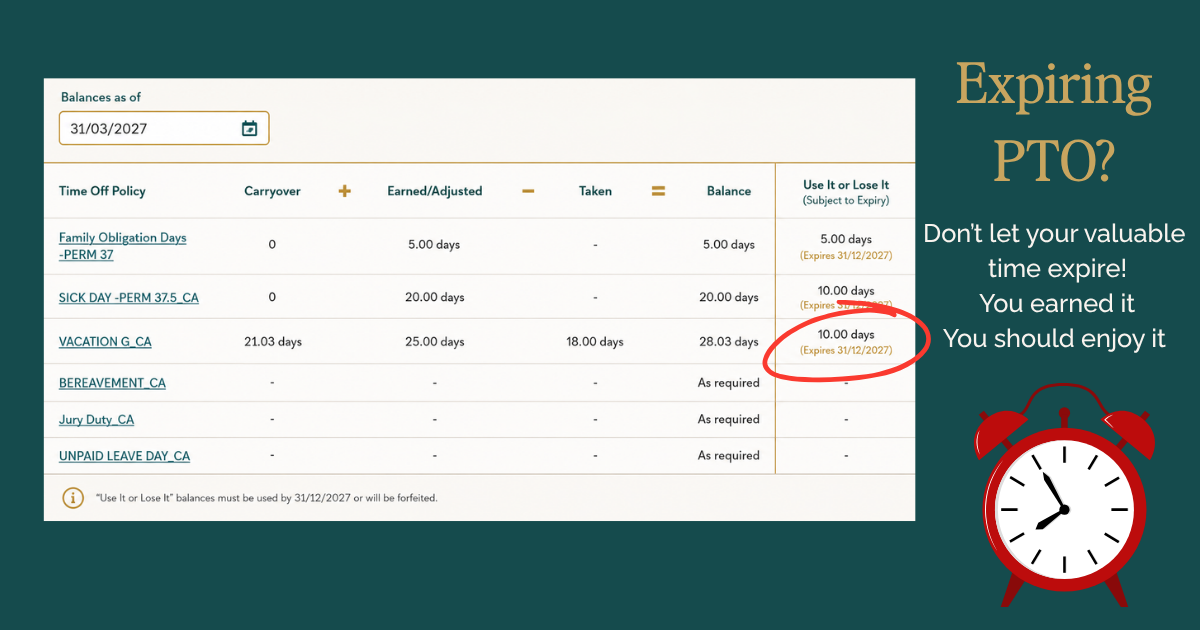
Robert Half surveyed a thousand Canadian workers this year and found that at least 40% of us don't use all the paid time off we're given. That number on its own isn't surprising. It's the reason underneath it that stopped me: 60% said they were holding on to their days in case they need them later.
Read that again. In case they need them.
Except that isn't usually how it goes, is it. The days do get spent — on a parent's surgery. On a kid's crisis. On the week the basement flooded, or the transition at work that couldn't happen without you, or the friend who needed someone and you were the someone.
The days aren't unused. They're reserved. Held quietly in escrow against somebody else's emergency, by a woman who has been the emergency contact for so long she's forgotten she's allowed to be the reason.
You are a capable, intelligent, accomplished woman. You approve budgets. You make decisions other people are afraid to make. You have never once needed permission to book a dentist appointment, hire a contractor, or change the entire direction of your career.
And yet.
Ask you to take a week — a week that is unambiguously, unapologetically yours — and suddenly there's a reason it can't be this year.
The reason is never the reason
Here's what I hear, almost word for word, over and over:
It's a bad time at work.
I should really wait until my husband can come.
My daughter's in her last year — I want to be around.
Next year will be easier.
Every one of those is true. That's exactly what makes them so effective. They aren't excuses. They're real, load-bearing facts about a life full of people who depend on you.
But I want to challenge that gently, because it's one of the most common things I hear — and one of the first things women tell me they were wrong about, once they finally went.
Next year has been easier for about six years now.
The cost of later
We talk endlessly about what a trip costs. We almost never talk about the cost of later.
So let me tell you what deferral actually charges you.
Researchers once surveyed more than 1,500 adults, comparing people who took a holiday against people who stayed home. The vacationers were measurably happier — but the boost showed up mostly before they left. In the anticipation. In the weeks and months of looking forward to it.
Which means the thing you keep postponing isn't only a week away. It's the months in front of the week. The evenings with a map open on the kitchen table. The text to your friend that says okay, I think I'm actually doing this. That isn't a bonus feature of travel. It appears to be where a great deal of the happiness actually lives — and every year you defer, you simply don't collect it.
Later is not free. It has a price. Most of us just don't see the invoice until much further down the road.
And there's a quieter cost, harder to measure. Every year you don't go, the story sets a little firmer. I'm not really someone who does that. Say it long enough and it stops describing your circumstances and starts describing you.
What it looks like when it breaks
One woman told me she'd let her vacation days expire six years running.
Not dramatically. Not in protest. The year would simply run out, the days would quietly vanish, and she'd think next year.
Then one ordinary afternoon she blocked off a week. On a whim. Before she could talk herself out of it. She told me she did it fast on purpose — the way you'd pull off a bandage — because she knew that if she gave herself one evening to think it through properly, she would find a reason not to.
She didn't have a plan. No companion lined up, no itinerary, no answer ready for what she'd tell her team.
She took the days first, for once, and figured out the rest afterward.
That order matters more than almost anything else I could tell you.
"But I wouldn't know what to do with a week"
This is where the practical objection usually arrives, and it's a fair one. For a lot of women, the days aren't the only obstacle. The planning is.
You've spent your whole life being the one who thinks of everything. So the idea of building a trip from nothing — flights, hotels, trains, restaurants, what on earth to do on a Tuesday in a city you've never seen — doesn't sound restful. It sounds like a second job.
Which is honestly a large part of why so much of my work happens on rivers now.
A river cruise quietly removes almost every point of friction that keeps a capable woman at home. You unpack once — no logistics tax, no 6 a.m. train, no mental load of hauling yourself from place to place. The excursions are handled, which is another way of saying someone has already thought of everything so that you don't have to. The ships are small, so you're known by name rather than by cabin number. And you dock in the centre of town rather than at an industrial port an hour out, so stepping off the ship means stepping straight into the day.
If you're going on your own — which more women are, and it's one of the better decisions I watch them make — the ship does the difficult social work for you. Company is there at dinner if you want it. And nobody blinks if you'd rather take your coffee up top and watch the water go by alone.
None of that is why you should go. But it's very often what makes going possible.
The question worth sitting with
I don't think any of this is really about vacation policy.
I think it's about who we were trained to put first — how early, and how thoroughly. And I think most women don't need convincing that they should go. They need permission to stop waiting for a year that arrives already cleared of everyone else's needs.
That year isn't coming. She's been expected for a long while now. She won't show up.
So here's what I'd ask you instead. What would it take to use the days on yourself first, for once? Not last. Not with whatever's left over after everyone else has been boarded. First — before they get quietly reallocated to somebody else's hard month.
You don't need to know where you're going yet.
You just have to take them.
And if you'd like to talk it through with someone who has had this conversation a few hundred times, I'd love that. Not a sales call. Not a pitch. Just a conversation between two women who understand what it means to finally say: it's my turn.
Because it is.
It's your turn now.
Related field notes
The Permission Paradox: Why You're Still Waiting for Something Only You Can Give Yourself
The permission you're waiting for isn't coming from anyone else. It never was.
Read more →Girlfriend & Solo TravelIs River Cruising Good for Solo Travellers?
The short answer is yes. Here's what solo river cruising actually feels like — the single supplement, the safety, the friendships, and the freedom nobody warns you about.
Read more →Destination InspirationWhy River Cruising Is the Way I Travel Now
Not slow travel for retirees — a genuinely different way to see the world, at a pace that actually lets you feel it.
Read more →Ready to plan your own journey?
No pressure, no pitch. Just a conversation about what might be possible.
Work with PennyA personal note
When you're ready, I'm here
No pressure, no commission-driven pitch. Just an unhurried conversation about the river, the season, and the ship that fits the woman you are now.
— Penny