
Is It Safe for a Woman to Travel Solo on a European River Cruise?
✦8 min read
The Short Answer
Yes. I've sailed solo on AmaWaterways, Viking, and Avalon, more than once each, and I have never once felt unsafe doing it. A river cruise is one of the safer ways for a woman to travel alone in Europe, and everything below is what actually backs that up: the ship, the crew, the towns, and the small habits that make the difference.
There's a message I get more often than any other. It usually starts the same way: "This might be a silly question, but is it actually safe for me to do this alone?"
It's the real question every woman travelling alone wants answered before she books.
I've sailed solo on AmaWaterways, Viking, and Avalon, more than once each. I've stood on a gangway in the rain waiting to reboard. I've found my own way back through Budapest at dusk with nothing but a room key in my pocket. I've never once felt unsafe.
Here's what I actually get asked, and what's true.
Is It Safe for a Woman to Travel Solo on a European River Cruise?
Yes. A river cruise is one of the safer ways to travel alone in Europe, and I say that because I've done it myself, several times.
The ships are small. Usually 100 to 200 passengers. On a ship that size, the crew knows who's aboard, and every time you step off and back on, someone notices.
Europe itself makes solo travel easier than most people expect. Even where English isn't the first language, most people speak two or three, and I've never had a communication problem on a solo sailing, not once, not in a dozen countries.
Your cruise director works like a private concierge for the days you're on your own. If you want to head into town outside an excursion, they'll call you a taxi and tell you what a fair price looks like, so you're not guessing. They'll point you to a restaurant, a market, or whatever you're after. Most ships hand you a map, paper or digital, before you leave, so getting turned around isn't really a risk.
How Do River Cruise Lines Handle Medical Emergencies on Board?
Quickly, and you won't manage it alone.
Most river ships don't carry a full-time doctor. That surprises people who've cruised the ocean before, where a medical centre on board is standard. River ships are almost never more than a short distance from a shore-side hospital or clinic, and if something serious happens between towns, local emergency services can meet the ship at the next dock or lock, often within minutes.
If you need to see a physician, the ship arranges it in an English-speaking setting and often sends someone to stay with you through the appointment. I can speak to a smaller version of this myself. I'm a bit of a klutz on vacation, and I've taken my share of falls over the years. Every time, the crew has been right there with ice, elevation, and whatever I needed to keep managing. Ships also carry walking sticks and other small aids for anyone dealing with mobility challenges, temporary or otherwise.
Are Slip-and-Fall Risks High When Getting On and Off the Ship?
Somewhat, and it's worth knowing why before you go.
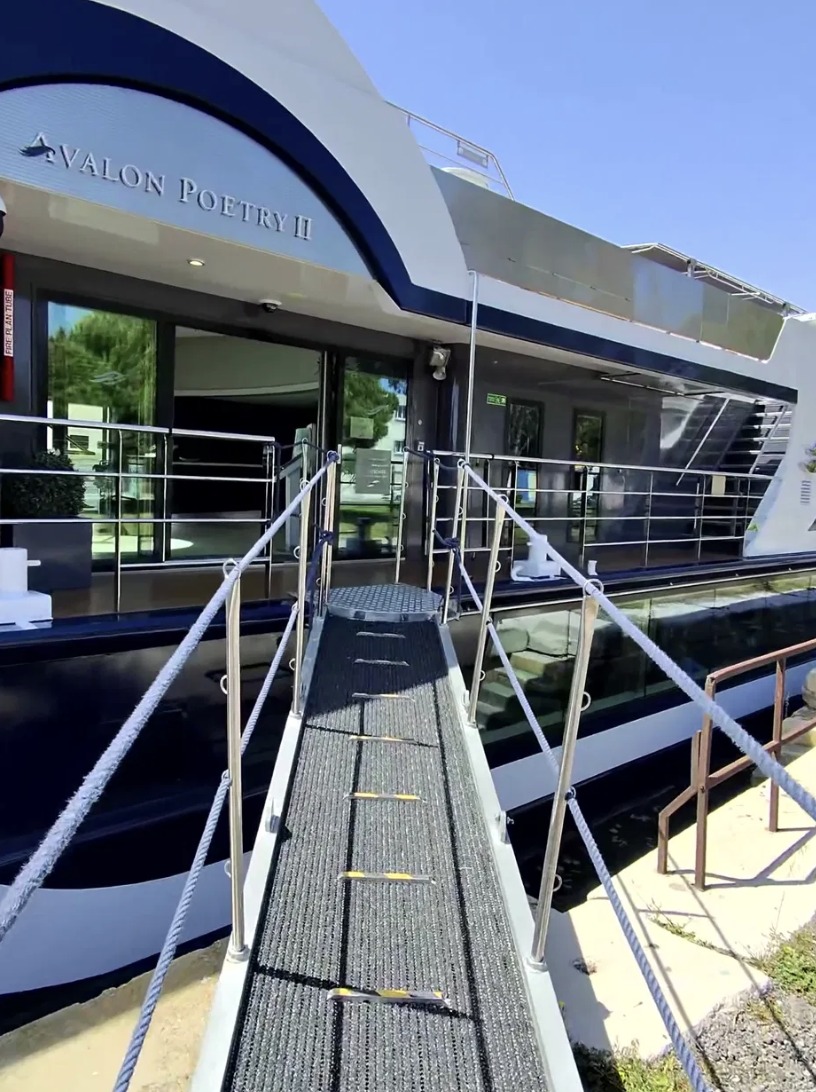
River ships often dock side by side, a practice called rafting. If your ship isn't first at the dock, you'll walk through another ship's lobby or sun deck to reach shore, which usually means more stairs than you'd expect. Boarding ramps also move with the water level, so they're rarely flat.
Then there are the towns themselves. European cities are old, and many buildings were never retrofitted with elevators the way North American ones tend to be. A full day ashore can mean a lot of stairs before you've even boarded. If mobility is a concern for you, plan around the towns as much as the ship.
The cruise line stations crew at every gangway to help you across, and they carry walking aids if you need one for the day. Wear real shoes. That's the tip that matters most.
How Secure Are the Ships at Night and in Public Ports?
More secure than most hotels.
Your room key card does double duty. It gets you on and off the ship, and it opens your cabin. Doors lock automatically, and desk staff monitor the entrance around the clock. Guest corridors aren't open to the public, so there's no one wandering through who isn't sailing with you.
Here's a detail I appreciate as someone who's actually used it: some cruise lines print the ship's name and phone number right on the card. Land in a big, busy port like Amsterdam or Budapest, and it's easy to blank on which ship is yours among a dozen others tied up at the dock. Look at the card. Call the number. The ship is always your first point of contact if you're lost or unsure, and getting you back is simply part of their job for the whole journey.
Is the Tap Water on the Ship Safe to Drink?
Yes, completely.
The ship filters and treats the water on board to a standard that's safe straight from the tap. Most ships also set up bottled or purified water stations before you head out for the day, so you're covered on excursions too.
That safety doesn't stop at the gangway. Port cities across Europe treat their tap water too, and many have public fill stations in the main tourist areas where you can top up a bottle for free.
In a restaurant, a server will usually ask you to choose:
- tap
- still
- fizzy
Ask for tap if you don't want to pay for water. No one will blink. Don't expect ice with it, though.
Are Guided Shore Excursions Safe, or Could I Get Separated From the Group?
Safe, and built to keep you found.
Guides use quiet-vox headsets, small earpieces that let you hear them clearly without crowding around like tourists at a monument. Tour managers count heads. Before you step off the ship, the tour manager hands you a card with local emergency numbers and the ship's details, so even if you did drift off on your own, you'd have what you need to find your way back.
How Safe Are the E-Bike Excursions Offered by the Cruise Line?
Safer than the cobblestones make them look, if you choose the right ride.
E-biking is one of the best ways to see a river town, and one where a little honesty helps before you sign up. European streets weren't built for bikes any more than the buildings were built for elevators. Cobblestones, tight turns, and city traffic are real considerations, especially if it's been a while since you've ridden.
Cruise lines require helmets and assign a local guide to every group. They also grade every tour by difficulty, so you can choose a flat towpath ride over a hillier one without anyone raising an eyebrow. Choose the ride that matches your fitness. No one's grading you on ambition.
Is It Easy to Get Around Europe on Your Own, Between Cities and Once You're There?
Yes, once you know the two or three things that catch people off guard.
I've gotten around Europe by plane, river ship, train, taxi, and ride-share. Uber works in most cities, though I usually reach for Bolt instead once I'm there, a service that runs the same way but tends to be cheaper. I've walked for hours through cities I'd never seen before and taken trains between them without ever feeling in over my head. I've never once felt unsafe doing any of it alone.
Trains are the part that surprises people most, so here's what actually matters. Staff wait at the station to answer questions, point you to your platform, and explain how the departures board works. European trains run on time in a way North Americans aren't used to: if the board says 10:20, the train leaves at 10:20. Your platform usually shows up on the board about 20 minutes before departure, so once it posts, you head there and get settled. There's no lingering over a coffee once your number comes up.
Pack with trains in mind if they're part of your trip. A large suitcase is hard to manage on board, since trains don't have the storage a plane does, and you're usually lifting your own bag on and off unless you're at a major station with porters. A carry-on-sized case with real wheels makes the whole thing easier.
What I Always Tell My Clients Before They Go
A few personal habits, alongside everything the ship and its crew handle:
- Wear a crossbody bag, not a shoulder bag. You can shift it to sit in front of you in a crowd and see it at all times.
- Look for a bag with slash-resistant straps and zippers that lock. Both are built specifically to slow down a pickpocket.
- Use an RFID-blocking wallet or card sleeve so no one can scan your cards from a distance.
- Stay aware of what's around you. It does more for your safety than any bag or wallet feature.
- Set yourself up with data before you land, either through your phone plan or an eSIM, so maps and messaging work the moment you step off the plane. I recommend this to every client. If you don't end up needing it, that's fine. If you do, you'll be glad it's there.
I travel with Wise, an international debit card that moves easily between currencies and keeps my main accounts a step removed from anything that happens on the road. I still bring my regular cards, but I'll often leave them in the ship's safe and use Wise for everything while I'm out.
I wrote this from having done it myself, alone, more than once, on more than one river.
If safety is the only thing standing between you and a river you've wanted to see, I'd love to talk about what that could look like for you. Not a sales call. Not a pitch. Just a conversation.
It's your turn now.
Questions I hear often
Related field notes
Is River Cruising Good for Solo Travellers?
The short answer is yes. Here's what solo river cruising actually feels like — the single supplement, the safety, the friendships, and the freedom nobody warns you about.
Read more →Permission & IdentityThe Permission Paradox: Why You're Still Waiting for Something Only You Can Give Yourself
The permission you're waiting for isn't coming from anyone else. It never was.
Read more →River Cruise EducationWhat Should You Pack for a European River Cruise?
The honest answer is less than you expect. A medium suitcase and a small daypack are genuinely all you need.
Read more →Ready to plan your own journey?
No pressure, no pitch. Just a conversation about what might be possible.
Work with PennyA personal note
When you're ready, I'm here
No pressure, no commission-driven pitch. Just an unhurried conversation about the river, the season, and the ship that fits the woman you are now.
— Penny